
Imam al-Ghazali's letter to the Governor
Al-Ghazali's letter of reply to the governor of the Nizamiyya Madrasa, written from retirement, on sincerity and the corruption of scholarly life.
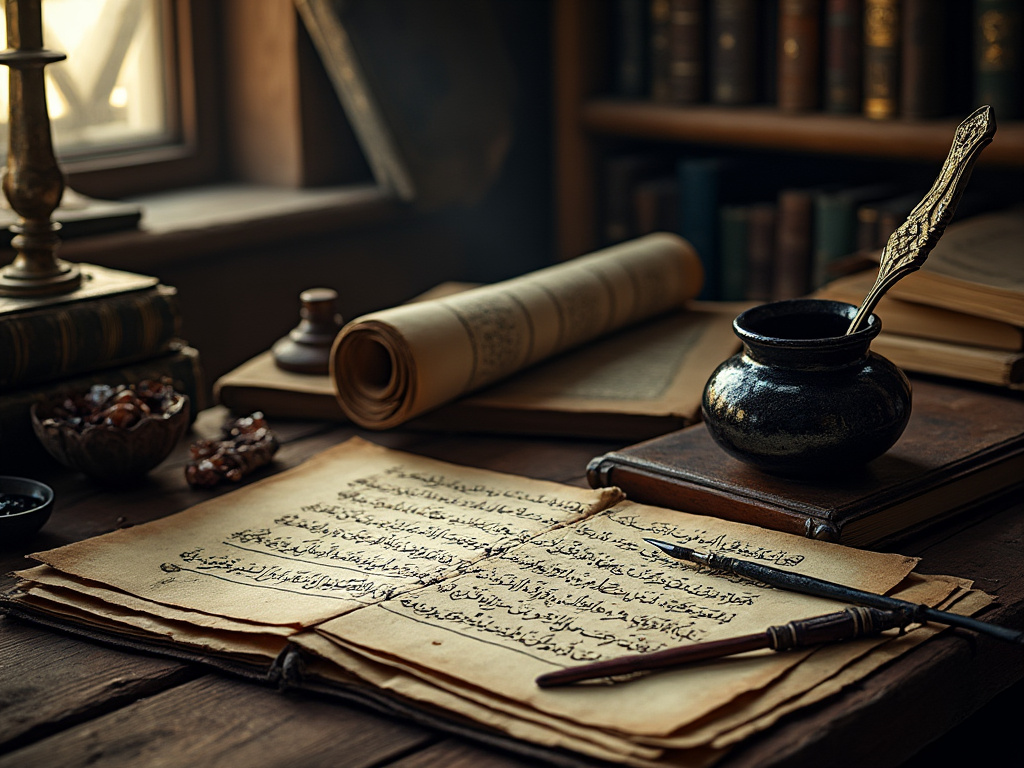
The following is the letter of response by Hujjat al-Islam, Imam al-Ghazali to Diya’ al-Mulk Ahmed son of Nizam al-Mulk, who was in charge of the Nizamiyya Madrasa of Baghdad in about 504 AH, corresponding to 1110 C.E.
The governor had sent a letter to al-Ghazali requesting his return to teach at the famed Nizamiyya Madrasa in Baghdad. At the time al-Ghazali had mostly retired from public life and limited himself to teaching a hundred or so students in his home town in Tus (present-day Iran).
Al-Ghazali’s response was as follows:
In the name of Allah, the Most Gracious, the Most Merciful.
Praise be to Allah, Nurturing Lord of all Worlds. Peace and blessings be upon the master of the messengers and all his family. Allah Almighty said: ‘To each is a goal to which Allah turns him; then strive together towards all that is good.’ [Al-Baqarah: 148].
People, in terms of what they have made their qiblah (focus of attention), are of three levels: The common masses who are heedless, the righteous elite who are clever, and the elite of the righteous elite who are insightful.
As for the heedless, they have limited their perspective to immediate benefits, thinking worldly pleasures are the greatest good. They considered it the foundation of wealth and status, so they pursued and cherished it. The Messenger of Allah, peace and blessings be upon him, said: “Two hungry wolves let loose among sheep in a pen do not cause more damage than a Muslim’s craving for wealth and status does to his religion.”
These heedless ones could not distinguish between the wolf and the prey, nor between coolness and heat. They chose a crooked path, claiming it to be elevated. The Prophet, peace and blessings be upon him, foretold their delusion, “The slave of the (gold) dinar is miserable. The slave of the (silver) dirham is miserable.”
As for the righteous elite, their cleverness and comparing this world with the Hereafter led them to prefer the latter over the present, as it is better and more lasting. The eternal is superior to the temporary, the fleeting. They turned away from worldly life and directed their faces in the direction of the Hereafter. But they also fell short by not seeking the Absolute Good, even if they were content with what is better than this world.
As for the elite of the righteous elite, who are those of insight, they recognized that preferring the Hereafter to this world is not the Absolute Good, and that everything other than the Absolute Good is transient (by its true nature). And the wise do not love the transient. They realized that this world and the Hereafter are creations, and that most of their desires are shared by animals and humans alike. This is not a suitable rank for them.
Allah, the Absolute Good, is the Master of the Day of Judgment, and to Him belongs the dominion of this world, and He is its Creator, He is better and higher. The elite of the elite were blessed to understand the essence of His words, “And Allah is better and more lasting” [Taha: 73]. They chose the “…the seat of honour int the presence of the Most Powerful Sovereign” [Al-Qamar: 55]. They preferred it above and over the rank of “Indeed the companions of Paradise, that Day, will be be busy enjoying themselves” [Ya-Sin: 55].
Rather, they grasped the reality of “There is no god but Allah” and knew that a person is a slave to whatever binds his soul. Whatever demands the focus of his soul becomes his god and object of worship. “Have you seen the one who has taken their own desires as their god?” [Al-Furqan: 43]. The aspiration of every soul is its object of worship, thus the Prophet, peace be upon him said, “The slave of the (silver) dirham is miserable.” Whoever’s aspiration is other than Allah, his tawheed (monotheism) is yet to be perfected, and he is not free from “the hidden shirk” (minor polytheism).
They (elite of the elite) divided everything in existence into two opposing categories: Allah and everything else. Like the two pans of a scale, they make their hearts the scale’s pointer. When they found their hearts willingly inclining towards the heavier pan (of good deeds), only then did they say, “The scale of good deeds has become heavy.” They were certain that whatever good they could not weigh on this scale, they could not hope for its weighing on the scales of good deeds on the Day of Reckoning.
The state of those in the second level in the eyes of the third level is like the state of those in the first level to those in the second level: commoners who do not understand their words, and do not grasp that whoever truly focuses his attention to Allah Almighty is honoured above others.
When the head of the ministry invited me – may Allah grant him the highest ranks, from lowly, worldly ranks to the highest spiritual rank – I invite him in return to ascend from the level of the heedless, which is the lowest of the low, to the highest of the high (the elite of the spiritual elite). The Prophet, peace be upon him, said: “Whoever does good to you, reciprocate it back.” And I have not found a way to reciprocate and repay the Vizier back. I have been unable to assist him with a positive response (to his request). So let him take up the journey from the low degree of the heedless masses to the elevated station of the elite.
The path to Allah is one, whether from Tus, Baghdad, or other countries, but some are closer than others, and thus they are not equal. Let the Vizier truly know that if he leaves one of the obligations that Allah Almighty has imposed, or commits what is forbidden by the Shariah, or if he enjoys sleep while there is one oppressed person in the land writhing in pain, then his rank is only the lowliness of the first level, and he is among the heedless. “Those are the heedless. They are the losers in the Hereafter.” I ask Allah Almighty to awaken him from the sleep of heedlessness so that he may look at his today to better his tomorrow before it slips from his hand.
We return to the talk of the Baghdad school, and the excuse for refraining from the Vizier’s request. Leaving one’s homeland is only sought for seeking an increase in religion or seeking an increase in worldly matters. As for the world, its pursuit has been removed from the heart, praise be to Allah Almighty. If they brought Baghdad to Tus and prepared kingship and kingdom for Al-Ghazali, and handed it over to him, and Al-Ghazali looked at it with desire, that would be due to weakness of faith, for desire (for this world) is one of its results.
As for the increase in religion, it indeed requires action and seeking. There is no doubt that the outpouring of knowledge there (in Baghdad) is easier, its means are more abundant, and its seekers are more numerous. However, the excuse is that travelling there causes a defect in religion that this increase in knowledge will not fill. For here there are about one hundred and fifty diligent, pious students busy with learning. Moving them and preparing their means is impractical. And there is no concession to leave them and break their hearts and hopes to travel elsewhere where there are more like them. This is like a man who takes care of ten orphans and then abandons them to attend to twenty in another place, all the while, death and calamities are in his pursuit.
Years ago, when the martyred vizier Nizam al-Mulk, may Allah sanctify his soul, called me to Baghdad, I was alone, without family or children. Now I am responsible for family and children, and it is not permissible to neglect them or break their hearts.
The third excuse is that when I reached the tomb of Abraham, peace be upon him, in the year 489 AH, about fifteen years ago, I vowed not to accept money from any ruler or their associates, not to go out to greet any ruler or sultan, and not to debate. If I break this vow, time (dedicated to this vow) will be wasted, the heart will be negatively affected, and I will not be able to do anything in worldly or religious matters. Debate is inevitable in Baghdad, and there is no escape from greeting the caliphate there in the capital. I have not greeted any leader in Baghdad since I returned from Syria, have not engaged in any employment, and have chosen seclusion. If I take on such a responsibility, I cannot live soundly as it causes the heart to reject seclusion.
The greatest of these excuses is that I do not accept money from rulers, and I have no property in Baghdad so the door to livelihood is closed there. This lowly one has an estate in Tus that suffices for this weak one and all his children after exercising utmost frugality and contentment. If I leave, it will fall short of that. All these excuses are religious, and they are significant to me even if most people think them trivial.
Finally, I have reached old age. This is a time of farewell before parting, not a time for traveling to Iraq. I hope from your noble character that you will accept this apology. Imagine that al-Ghazali came to Baghdad and Allah’s command (of death) came to him. Shouldn’t another teacher be prepared? So do this today, and peace be upon you. May Allah Almighty adorn the chest of the world with the reality of faith that goes beyond mere outer-forms of faith, so that the world may prosper through it. Praise be to Allah the praise He deserves, and His blessings and peace be upon His Prophet and his family.
Extracted from ‘This is how the generation of Saladin appeared and Jerusalem Re-captured’, our forthcoming publication, by the late Dr. Majid Arsan al-Kilani.
Originally published on the Dhikr Substack.